

 Français
  English
 Español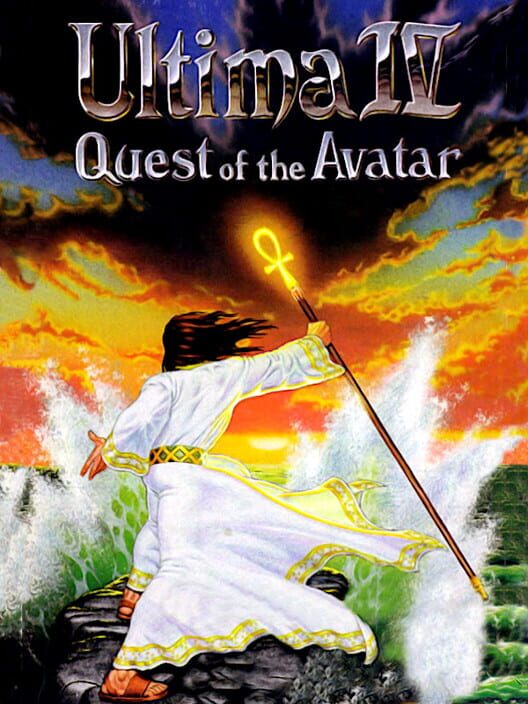
Game entry
Ultima IV: Quest of the Avatar
1985 · RPG · Apple II · Origin Systems
Ultima IV: Quest of the Avatar is ranked no. 2,534 among the best video games of all time by GameForever voters, with an ELO score of 1,474 and 35% of duels won. In its strongest family it holds position no. 8 out of 16 (1985).
World rank
no. 2,534
ELO score
1,474
Wins
35%
Duels played
51
About Ultima IV: Quest of the Avatar
Following the defeat of the evil triad in the previous three Ultima games, the world of Sosaria changed beyond recognition: continents rose and sank, and new cities were built, heralding the advent of a different civilization. Unified by the reign of the benevolent monarch Lord British, the new world was renamed Britannia. Lord British wished to base people's well-being on the ethical principles of Truth, Love, and Courage, proclaiming the Eight Virtues (Honesty, Compassion, Valor, Justice, Sacrifice, Honor, Spirituality, and Humility) as the ideal everyone should strive for. The person who could accomplish full understanding and realization of these virtues would serve as a spiritual leader and a moral example for the inhabitants of Britannia; he alone would be able to obtain holy artifacts, descend into the Stygian Abyss, and access the Codex of Ultimate Wisdom. This person is the Avatar.
The fourth game in the Ultima series features an improved game engine, with color graphics and enhanced character interaction: the player can have conversations with non-playable characters by typing names of various topics. However, the main difference between Ultima IV and its predecessors in the series (as well as other role-playing games) lies in the game's objectives and the ways to fulfill them.
Instead of building up a character by any means possible in order to face a villain in the end of the game, in Ultima IV the player is trying to become the Avatar, a role model for people. This means upholding the Eight Virtues, basically trying to become a better person. Making morally conscious decisions and helping other people is not done expecting a material reward, but because it is the actual goal of the game and the main focus of its gameplay. The game frowns on behavior typical of most other RPGs, such as backstabbing fleeing enemies or picking up everything that isn't nailed down even if it does not belong to the protagonist. This different approach established the game's reputation as the first "true" Ultima, influencing the design philosophy of later installments and the overall spirit of the series.
Character creation is done by choosing responses to morally ambiguous questions. Each of the Eight Virtues corresponds to a character class; by determining the player's personal priorities in the virtues, the game assigns a class and a starting location for the Avatar. After emerging in Britannia, the player is free to explore it in various ways (on foot, moongate teleportation, on horseback, by ship, etc.). Certain items must be collected in any order to enter the Stygian Abyss and complete the game. The Avatar also has to reach the highest level in all virtues. This is achieved by various means: donating blood increases Sacrifice, not fleeing from combat increases Valor, etc. The process, however, is not irreversible: should the Avatar overpay a blind seller, he gains Compassion points; should he, on the other hand, cheat the seller by underpaying, his level in several virtues would decrease.
These unorthodox features of the game co-exist with plenty of traditional RPG elements, such as dungeons to explore and hostile monsters to kill. Enemies are encountered on the world map as well as in dungeons; combat takes place on separate top-down screens, allowing player-controlled and enemy parties freely move on them. Characters accumulate experience points and level up, gaining higher amount of hit points and access to stronger magic spells. Like in the previous installments of the series, world map, town exploration and combat are presented from a top-down view, while the dungeons are pseudo-3D and are explored from first-person perspective.
Ultima IV also introduces several new gameplay features to the series and role-playing games in general. A number of initially non-playable characters living in various areas of the game world are able to to join the party and fight alongside the hero, replacing traditional player-generated characters or mercenaries and adventurers available only in special locations. Additional new elements include buying and combining reagents in order to cast spells, puzzle rooms in dungeons, and others.
ELO progression
Score moved from 1,500 to 1,474 ELO points over the last 170 days.
Head-to-head
Direct record on the most played match-ups.
- against Star Wars: The Old Republic 0% 2 duels played · 177 points behind
- against Dishonored 50% 2 duels played · 335 points behind
- against Crusader Kings III 0% One duel played · 332 points behind
- against Might & Magic Heroes VII 100% One duel played · 31 points behind
- against Guild Wars 2 100% One duel played · 149 points behind

In the same genre
All RPG games →


Keep exploring
Around this spot
The games Ultima IV: Quest of the Avatar sits between in the world ranking.
- 2,531 Yo-kai Watch 1,474
- 2,532 PewDiePie's Tuber Simulator 1,474
- 2,533 Mega Man Legends 1,474
- 2,534 Ultima IV: Quest of the Avatar 1,474
- 2,535 Rise Online 1,474
- 2,536 Sly Cooper and the Thievius Raccoonus 1,473
- 2,537 The Final Station 1,473
More games from Origin Systems





The standing
Where Ultima IV: Quest of the Avatar ranks
The world rank mixes every family of games. Here is where Ultima IV: Quest of the Avatar stands in each of the ones it belongs to. Its best standing, all families considered: 8 out of 16 (1985).
| Ranking | Position | Games competing |
|---|---|---|
| World ranking | 2,534 | 5,035 |
| RPG | 56 | 87 |
| 1980s | 63 | 155 |
| 1985 | 8 | 16 |
The community
The debate
0 comments
Posting requires an account: log in or sign up.
The debate is yours to open.
Nobody has spoken up about this game yet. Say what it's worth, and the thread starts here.
See the whole Ultima IV: Quest of the Avatar debate →